Showing posts with label Movies. Show all posts

Aug 21, 2012

You Just Don't Get It, Do You?


There are certain Hollywood cliches that you see a lot. Dialogue or scenes that have been done so often they are stale, tired and evidence of lazy writing. Here are a couple of examples I can think of right off the bat:
  • The homicide detective who arrives at a crime scene and asks, "What have we got?"
  • A character noticing he/she's being followed by someone, and saying, "We've got company."
  • The irresponsible, reckless, weird or lazy main character whom nobody thinks highly of being the one that somehow saves the day (a tired action movie plot device if there ever was one)
And of course, the line, "You just don't get it, do you?"

It's more commonly used than you might think. 

Jul 8, 2012

A Tribute To Ernest Borgnine


"There are no small roles, only small actors."
-Ernest Borgnine, Dragoncon discussion panel, 2011


One of my favorite actors passed away on Sunday, July 8th 2012, after having a full life and a movie career that spanned over sixty incredible years.

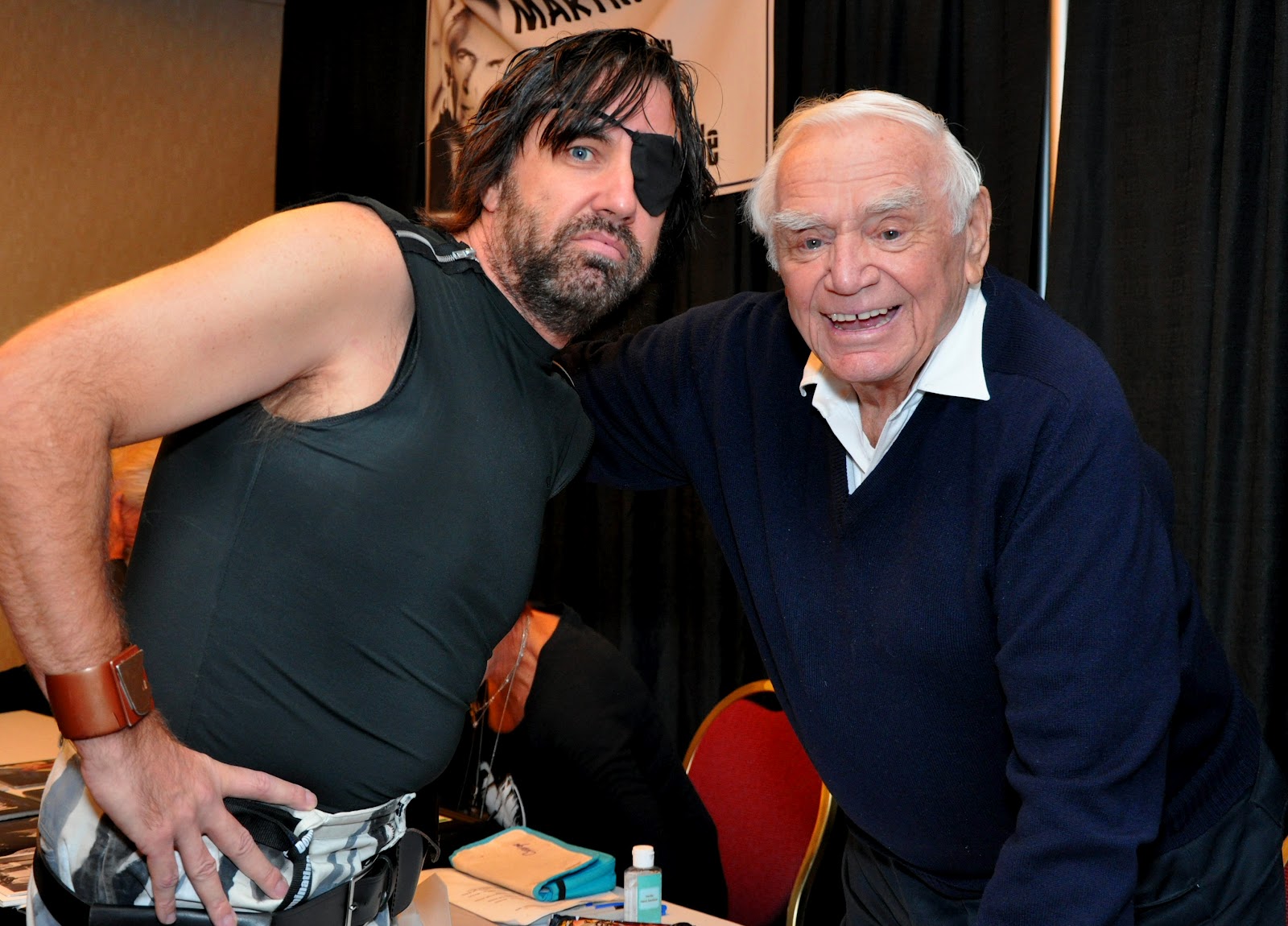
Ernest Borgnine, born Ermes Effron Borgnino, was an American institution and accomplished actor. I was lucky enough to get an autographed picture and a photo taken in costume with him at Dragoncon in 2011.

LINK
 to New York Times article

Ernest Borgnine, a larger than life figure, retained a zest for life and infectious laugh right up until the end. A modest, unassuming man who, when not acting,  traveled in an RV mingling with the public, starred in a seemingly endless list of movies and television shows, not demanding the limelight, but viewing acting as being part of an ensemble (unlike stars such as William Shatner, who was known to count lines in a script to make sure he had the most dialogue). He was charming, gracious, talented and grateful to his fans. He was truly one of the great ones, and the world is a sadder place in his absence.

Some of his most memorable roles included:
  • Marty in Marty
  • Quinton McHale, McHale's Navy
  • Major General Worden in The Dirty Dozen
  • Mike Rogo, The Poseidon Adventure
  • Shack, Emperor Of the North
  • Sheriff Lyle "Cottonmouth" Wallace, Convoy
  • Cabbie, Escape From New York
  • Dominic Santini, Airwolf (television series)
LINK to Wikipedia entry about Ernest Borgnine

In the picture above, I am at Dragoncon in 2011 in my Snake Plissken costume, a character from the John Carpenter cult sci-fi film Escape From New York, and was lucky enough to get a picture with him in costume. Borgnine played the role of Cabbie:


In this clip, Mr. Borgnine talks about his role in the movie in Escape From New York:


Ernest Borgnine's last interview (jump to :55 on the video). At 3:10 in the video below, Ernest Borgnine talks about what he's learned in the film business, which explains why he was such a successful actor, and why he will be so missed and mourned by his fans and colleagues:


One of his more memorable roles in the 1970s was Sheriff Lyle Wallace in the trucker movie Convoy. In this scene he commandeers a car to catch up with the convoy of trucks. You can watch the entire movie HERE. It was one of the most famous of the '70s trucker movies, directed by Sam Peckinpah, based on a song by C.W. McCall. It glamorized the life of the American trucker, not very realistically. But Borgnine's performance carries the film. Jump to 9:30 to see a good scene between Kris Kristoferson and Ernest Borgnine.


A scene from McHale's Navy, which gave Mr. Borgnine a much wider audience:


A great clip from Dragoncon 2011 where Mr. Borgnine did a discussion panel. I was not able to make this one, to my great regret. I wish I had. You can watch the entire discussion panel HERE (fortunately someone recorded it for us!)


Goodbye, Ernest. The world will miss your presence.


Jun 3, 2012

Publishers Have Virtue

Cory Doctorow, Boing Boing editor, writer and graphic novelist, has a great essay on how the publishing industry has virtue, as opposed to the music and movie industry, which rip off artists and deny them royalties at every turn, cram lopsided contracts down their throats, and pummel users with threats and attacks, which only affect the people who have legitimately bought their products not those for whom the threats are intended. 

The publishing industry, in comparison, tends to treat artists with a lot more transparency and fairness, and should be proud of this fact.

Finally, authors’ advances are (usually) only charged to their current books, or sometimes across a single deal. Unlike musicians, who are often required to pay back shortfalls from their last project before they can start earning on their latest one, authors’ balance sheets are zeroed out with each new book. If your last book tanks, your next book usually doesn’t have to pay back its advance. Publishing doesn’t do debt slavery.

Apr 17, 2012

Salesman - The 1968 Documentary

This is a real treasure of American documentary film making, and well worth watching.

Salesman is a low budget documentary filmed in 1967 and follows four door-to-door salesmen who deal with constant rejection, homesickness and the inevitable burnout as they go across the country selling very expensive bibles to low-income Catholic families.

The focal point of the film is salesman Paul Brennan, who is the Willy Loman character in this film, and it is heartbreaking to watch him struggle to make sales, as it becomes obvious his heart just isn't in it any more.

What makes this film so special is its honesty. Filmed on a shoestring, there are no staged camera interviews and no fancy production values. This is a pure slice of American life that follows four door to door salesmen in their quest to sell overpriced bibles to poor working class families that cannot afford them. Once you start watching it you'll be pulled into a world that doesn't exist anymore. Below is a fourteen minute clip. Link to official website


The director talks about making the film, and his friendship with Paul Brennan HERE

Mar 31, 2012

The MPAA: Bully of Film Makers

The Motion Picture Association of America, or MPAA, is the national film ratings agency that reviews films and applies the ratings to them, be it G, PG, PG-13, R or NC-17 (which used to be XXX).


image credit: http://www.pictureshowman.com/articles_genhist_censorship.cfm


It is also a group that many filmmakers hate.


It is the reason why you see the above screen in theaters at every movie you go to. Their review decisions are made in secret, infuriating film makers, who are given little to no information about why a film has been given a particular rating. The appeals process allows no documentation or recordings, and produces no written judgments, and is a system in which the deck is stacked against the filmmakers. 


This is a problem, because films that are released unrated, or worse, with an NC-17 rating, are often not shown in the big movie theater chains. While the MPAA claims its rating system is voluntary, the reality is that it is a form of censorship, because unrated films are seen by far fewer people. It is a system that thrives on secrecy and has been resistant to change.

The most recent example is the film Bully, from Miramax, about the trauma of school bullying. The MPAA gave it an NC-17 rating for some offensive language (the kind heard in schools across the country) and refused to review its decision. As a result, Miramax is going to release the film unrated, even though that will lower the amount of theaters in which it can be seen.


This video covers the campaign to pressure the MPAA to back down on its arbitrary R-rating.


Turning The Spotlight On The MPAA


In the documentary This Film Is Not Yet Rated, Academy Award-nominated director Kirby Dick  puts the powerful MPAA under the microscope for inspection, looking at stateside cinema's most notorious non-censoring censors. 


Disturbed by the huge amount of power that the MPAA ratings board wields, the filmmaker seeks out the true identities of the anonymous raters who control what films make it to the multiplex (and which ones don't), hiring a private investigator to stake out MPAA headquarters.


Along the way, Dick speaks with numerous filmmakers whose careers have been negatively affected by the seemingly random judgments of the MPAA.

This is a fascinating documentary and well worth watching (be aware there are snippets of nudity and some coarse language, necessary to examine the issues covered in the film)


Predictably, the film was given an NC-17 rating by the MPAA, and Dick describes the unfair, arbitrary nature of the appeals process. 


The MPAA was also caught red handed making copies of the film, something they go after others for, but the MPAA justified its hypocracy  by claiming it was acting to protect its members (story about this HERE).  Apparently the same rules they so zealously advocate for do not apply to them.


The bottom line is the fact that the MPAA has an enormous amount of control over what movies the public is allowed to see, and there are movies that do not get made or released at all because of this system, something that damages the freedom of culture that is supposed to be a hallmark of our society.


Feb 13, 2012

V For Vendetta - An Analysis


The BBC gives Alan Moore space to write about the creation of V For Vendetta, and the inspiration for the Guy Fawkes mask, which has become a world wide symbol of resistance and protest (link at bottom).

What IS V For Vendetta? And who was Guy Fawkes?


Fawkes had been declining as a symbol of protest until the graphic novel, and the subsequent movie was released. 

Guy Fawkes belonged to a group of provincial English Catholics who planned the failed Gunpowder Plot of 1605, an attempt to assassinate King James I and VI of England and Scotland, by blowing up the House of Lords. Acting on a tip, authorities discovered Fawkes guarding thirty-six barrels of gunpowder. Fawkes and eight other conspirators were tried and hung for treason.

On November 5th of that year, people of London were encouraged to light bonfires to celebrate the failure of the King's assassination, and November 5th became known as Guy Fawkes Day.


The movie, directed by the Wachowski brothers (the same team responsible for The Matrix trilogy) has become a cult sensation for a variety of reasons.

Proof that the graphic novels format is not brain deadening waste of time, but can be important cultural counter points.

V For Vendetta seemed immediately relevant when it came out, with the memory of September 11, 2001 still raw, and the concerns over increasing government intrusions into our private lives, and the ever-growing surveillance of citizens, coupled with the reduction of civil rights, all in the name of security.

It was controversial from the start, with explosions of government buildings being a key part of the plot, and assertions that it encouraged and glamorized terrorism. The film, with its Hitler-like references and stinging commentary about America, inspired much debate when it was released in 2005. Additionally, one scene involves using explosives in a subway; the film's release was pushed back after real terrorists bombed a London subway.


The story is about V, a masked vigilante who appears in a London that has become a near dictatorship, with surveillance vans recording people's private conversations in their homes, and the state being all-powerful. High Chancellor Sutler is brilliantly played by John Hurt, who played Winston Smith in 1984, George Orwell's masterpiece about an omnipresent dictatorship.


V appears out of nowhere to institute a carefully planned attack against Sutler's totalitarian government for its unspeakable crimes, and in the process, rescues Evey, played by Natalie Portman. Hugo Weaving's performance is nothing short of phenomenal, even more impressive considering you never see his face (James Purefoy was originally cast to play V but was replaced by Weaving four weeks into production). Weaving was dropped into the role at the last minute, so some of the fancy knife and fighting sequences were done by a stunt man wearing the mask and costume.

Interestingly, Moore was very vocal about his displeasure of the film, which differed from the graphic novel it was based on in several ways, but there is no denying its cultural impact.

Below is an interesting interview with Weaving about his title role in the film.


LINK to program in which Weaving and Portman interview each other based on viewer questions (embedding for this video has been disabled)


LINKS

BBC op-ed with Alan Moore

V For Vendetta critical analysis

V For Vendetta Spells C For Controversy


May 1, 2011

Inside Job - The 20 Trillion Dollar Documentary

Everyone in America needs to see this movie.

I don't normally post movie reviews on this blog, but I'm making an exception for Inside Job, the Oscar winning documentary about the 2008 financial meltdown. Millions of people have lost their savings and their homes, entire towns and cities have been devastated, all because of the actions of a handful of people. This is not an anti-Republican, or anti-Democrat film; both parties were culpable in the economic devastation. Inside job takes us step-by-step, in an easy to understand manner, through the entire financial crisis, so that we can all understand how all of this happened. What happened has affected you, whether you realize it or not.

This is probably one of the most important films you will ever see.

Link to official Inside Job website

If you're interested in reading how truly evil and corrupt Goldman Sachs is, Rolling Stone has a great investigative piece here


On a related note, another extremely profound documentary is The Corporation, a film which examines how corporations behave, and the enormous consequences they have on our lives and our planet (most pf them negative)


On a related note, another extremely profound documentary is The Corporation, a film which examines how corporations behave, and the enormous consequences they have on our lives and our planet (most pf them negative)


Apr 16, 2011

The Hobbit - Behind The Scenes

Peter Jackson gives us a behind-the scenes look at pre-production of The Hobbit, and it looks like it is going to be just as awesome, epic and faithful to the book as Lord Of The Rings. I can hardly wait! 

Jan 31, 2011

1957 Book of Interior Decoration


I picked up this book at a thrift store for the low, low price of $1.90 cents. The Ladies Home Journal Book Of Interior Decoration, published in 1957, was filled with everything the postwar wife would need to know to decorate her household for the go-go fifties. Let's take a tour of our modern decor for a modern age, shall we?

{click all pictures for a larger view}

Let's start in the kitchen, the nerve center of a modern wife's world. The new fashion calls for bright colors, new materials, and stylized cabinetry and appliances. Look at the kitchen below. What was fresh and new in 1957 is now retro. People spend big bucks to make their kitchens look even somewhat like this nowadays.


Men and Kitchens
 
 "A man's gotta eat, but he's not gonna cook, not gonna set foot in the kitchen, except to pop a beer and cut enough salami to hold him until supper. Because the kitchen just ain't his domain. He could have been under a hood all day, fixing the piston rings of a flathead Ford; or in the operating room, performing a spinal tap on a kid who had a relapse of the mumps; or running the controls of a sixty foot crane - all delicate and painstaking jobs, requiring great skill and dexterity. But enter the kitchen, to be confronted with actually lifting a pan or slicing an onion or filling a pot with water, and he loses control of his major muscles, his coordination disappears, the laws of physics cease to function, and he winds up helplessly in the center of the linoleum.


"The one wrinkle, the one culinary ace up his sleeve, was breakfast. Finger to his lips, he wakes the kids on a Saturday morning and quietly leads them tiptoeing downstairs for Saturday breakfast. 'Whataya say, kids? We'll let Mom sleep. I'll make you guys some pancakes.'

"Out from the deepest recesses of the cabinetry emerge pots and pans that have not seen the light of day since the wedding shower. Bowls crusty with dust get a quick rinse. Because every piece of heavy equipment is needed for this invasion. All the big guns. No paltry European-style breakfast this. Dad's making a meal his way. And soon the Formica is littered with broken egg shells, gobs of flour and milk now hardened into glue, half-filled measuring cups and spoons, a Gypsy-family of bowls and pans and pots and somehow, in the one frying pan that made it to the stove, are gathered a small confederacy of pancakes, waiting to be flipped and served to the adoring,. awestruck progeny. And when, later that morning, the wife looks slack-jawed at the carnage in her kitchen, you can say, 'Morning, Honey, did you get some rest?'"


     From A Stiff Drink and A Close Shave - The Lost Art of Manliness by Bob Sloan and Steven Guarnaccia  LINK


And now let's retire to the living room, where today's fun, functional and stylish new look combines comfort and fashion while keeping up with the Joneses, who are undoubtedly reading the same magazine, since the wives are home all day while their husbands are at work! But, I digress...


Some of the living rooms look like fun places to spend time in, others look like museums, or the kind of room Grandmom had in her house that you were never allowed to go into when Mom and Dad threw you into the car and hauled you over there for the obligatory visit


Take this room for example. It's the perfect room for receiving heads of state, lobbyists with envelopes stuffed with cash and trusted advisers. As for comfort? Not so much.


This room is an assault on the eyes. Wallpaper like this should not be allowed to exist. I feel like I should be getting ready to choose my ice cream flavor and decide if I want sprinkles.


Note the TV with the tiny screen recessed into the wall unit. How did they see anything seated all the way across the room??


Here's another room with a tiny TV, recessed into the wall. This room looks much more lived in


This room has Grandmom written all over it. On one of the tables is a bowl of candies she puts out when she knows the grand kids are coming over. You can practically hear the slow, methodical ticking of a big clock somewhere.


For the occasions when you wanted to entertain in a more casual manner, you had a less formal room, like the ones below. I love the very cool looking TVs in the two pictures below, black and white of course.


Another crime against aesthetics;  the window covering is so loud you'd need ear plugs (and blinders) to spend any time at all in this room. And what's with the pink and green furniture??


It's the OPTICAL ILLUSION floor covering! For when normal floors just won't do!


And last, but not least, modern bedrooms


This picture demonstrates how to make a small apartment cozy


Grandmom's bedroom, with the faint fragrance of makeup, perfumes and mothballs for those outfits she wears only on Sundays or special occasions